
The PHP CMF that builds pages from components
Every component returns XML; XSLT renders the page into HTML or another format. Open source under MIT, developed since 2006.


Energine Simple with demo content — desktop and phone (interface in Russian)
- Since 2006
- MIT license
- PHP 8.4+
- MariaDB
- Interface in English, Russian and Ukrainian
Editions
Two editions, one engine
Both are free software under the MIT license. Energine Simple ships its interface in English, Russian and Ukrainian, Energine 2.13 in Russian and Ukrainian.
Recommended for new sites
Energine Simple
The core for small sites: a section tree and pages from templates, texts edited right on the page, users and rights, languages, security built in. In active development.
13 modules
Energine 2.13
The full set of modules — news, blogs, shop, forms, mailings, banners and more — for sites that need them and for 2.x projects. Released as it is, with its known risks named.
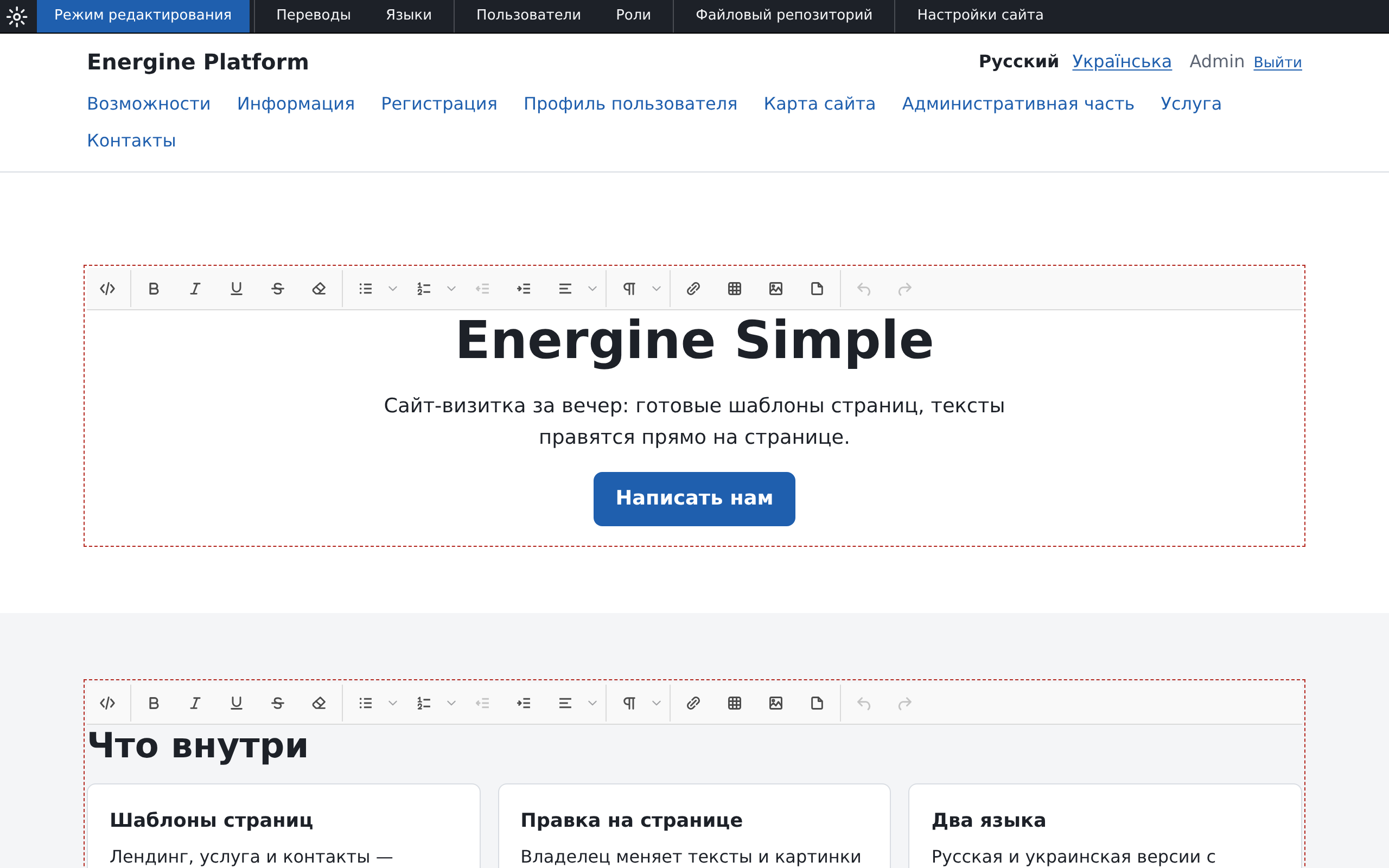
Energine Simple
Edit right on the page
The owner turns on edit mode and changes texts and pictures where visitors see them, in the Jodit visual editor. An empty section is hidden from visitors.

Energine Simple
An admin that stays small
The section tree, users and roles, interface translations, the file repository, e-mail templates, site settings, an action log and a report of broken links. A ? in the corner of an admin window explains what to do on that screen.
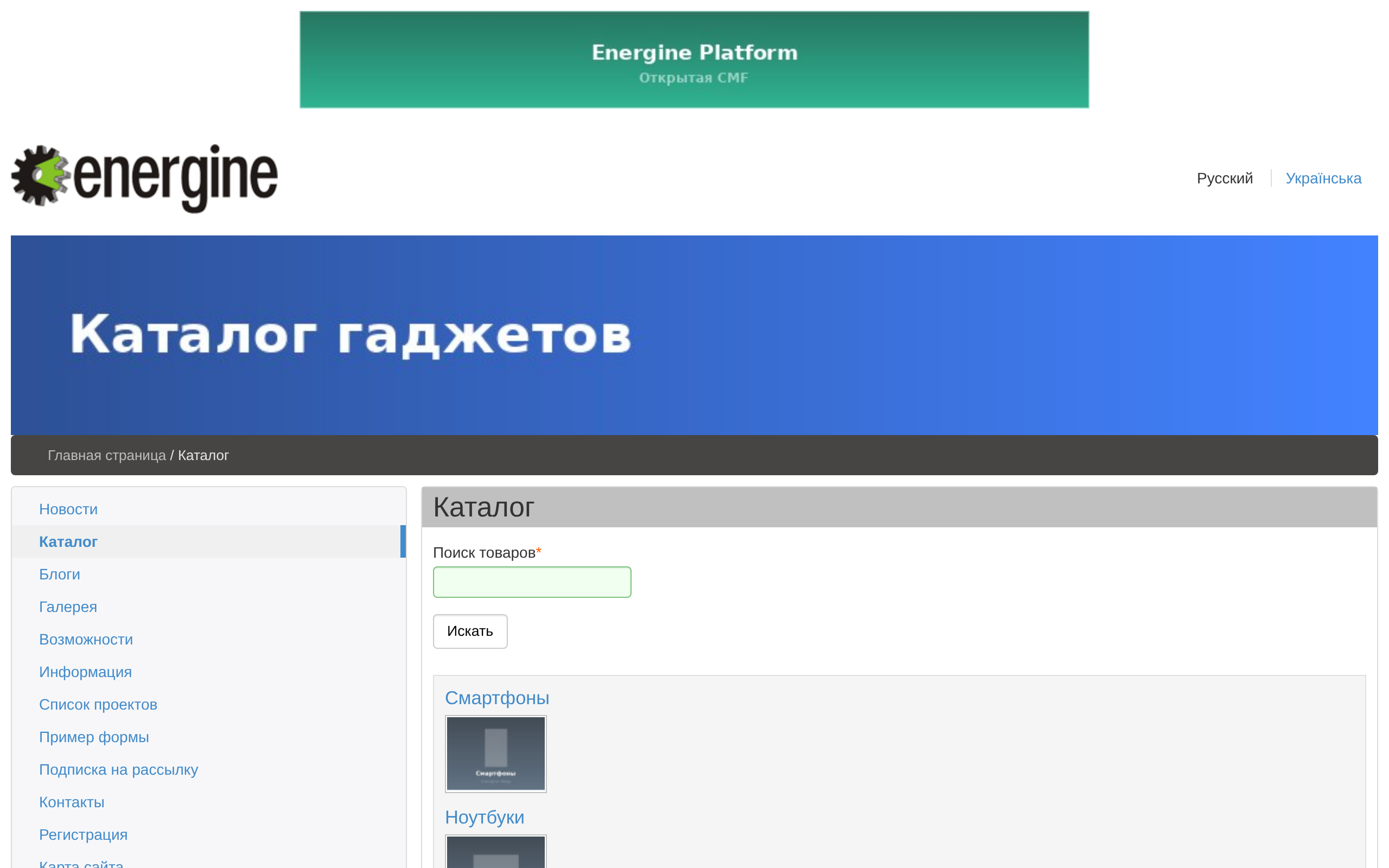
Energine 2.13
13 modules when you need them
Structure and content, news, blogs, shop, forms, comments, mailings, banners, files, users, languages, URLs and the admin — the modules of Energine 2.12, brought to PHP 8.4+ and MariaDB 10.11.
How it works
One XML document per page, rendered by XSLT
Every request goes to a single front controller. It finds the page for the URL — sections are stored in the database — and loads the page template: an XML list of the components the page is made of.
A component is a PHP object that does one job, such as a menu, a login form or a news feed, and returns its result as an XML node. The controller runs the components and collects their output into one XML document.
XSLT templates turn that document into HTML — or into another format, such as RSS.
In debug mode, add ?debug to a page address to get its XML document.
XML
<component name="breadCrumbs" class="BreadCrumbs" type="list">
  <recordset>
    <record>
      <field name="Id" type="integer" key="1">80</field>
      <field name="Name" type="string">Главная страница</field>
      <field name="Segment" type="string"/>
    </record>
    <record>
      <field name="Id" type="integer" key="1">3726</field>
      <field name="Name" type="string">Возможности</field>
      <field name="Segment" type="string">features/</field>
    </record>
    <record>
      <field name="Id" type="integer" key="1">3728</field>
      <field name="Name" type="string">Новости</field>
      <field name="Segment" type="string">features/news/</field>
    </record>
  </recordset>
</component>XSLT
<xsl:template match="recordset[parent::component[@name='breadCrumbs']]">
    <div class="breadcrumbs">
        <xsl:apply-templates/>
    </div>
</xsl:template>

<xsl:template match="record[ancestor::component[@name='breadCrumbs']]">
    <xsl:choose>
        <xsl:when test="position() = 1">
            <a href="{$BASE}{$LANG_ABBR}" class="breadcrumbs_home"><xsl:value-of select="field[@name='Name']"/></a> /
        </xsl:when>
        <xsl:when test="position() = last()">
            <xsl:value-of select="field[@name='Name']"/>
        </xsl:when>
        <xsl:otherwise>
            <xsl:if test="field[@name='Id'] != ''">
                <a href="{$BASE}{$LANG_ABBR}{field[@name='Segment']}"><xsl:value-of select="field[@name='Name']"/></a> /
            </xsl:if>
        </xsl:otherwise>
    </xsl:choose>
</xsl:template>HTML
<div class="breadcrumbs">
  <a href="https://example.com/" class="breadcrumbs_home">Главная страница</a> /
  <a href="https://example.com/features/">Возможности</a> /
  Новости
</div>History
Since 2006
Energine was created by Pavel Dubenko — lead developer: architecture, core, main modules and installer.
With Andy Karpov, Andrew Alexeenko, Sergey Kushniruk, Yuriy Ponomarev, Valeriy Zinchenko and other contributors.
- 2006
The first source code: the core's files still carry “@copyright Energine 2006”.
- 2007
energine.org is online — the earliest Web Archive snapshot is from February 2007.
- 2013
The code moves to GitHub (November).
- 2014
The 2.12 branch: tag 2.12.1 (May).
- 2017
The last 2.12 release, v2.12.85.07 (October).
- 2026
Energine 2.13 (October): PHP 8.4+, security fixes and repaired modules. Energine Simple: a smaller line of the engine for new sites.
Project
Status, plans and how to help
Energine 2.13 is released as it is; development continues in Energine Simple. Report bugs and propose changes on GitHub.